PyStormTracker Hodges Implementation
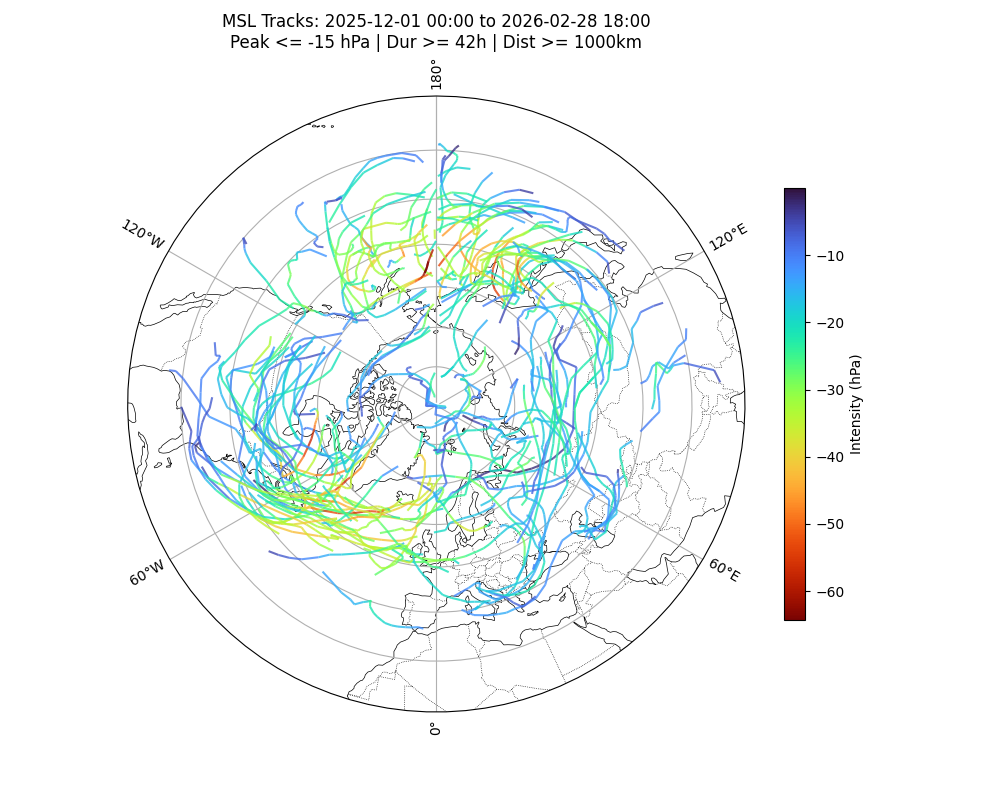
This document details the architecture, mathematical implementation, and design rationale for the Hodges tracking algorithm in PyStormTracker. The primary goal is algorithmic parity with the TRACK software (Hodges 1994, 1995, 1999) while updating the interface and performance.
1. Feature Identification Design
1.1 Preprocessing (Spectral Filtering & Derivatives)
Design Choice: Integrated native spherical harmonic filtering (e.g., T42 truncation) and high-precision derivative calculation using the ducc0 backend.
References:
spec_filt.c,uv2vr.c.Accuracy: See Spectral Filtering Accuracy for detailed RMSE/Correlation metrics against NCL.
Reasoning:
Original TRACK workflows typically require offline spectral filtering to remove the planetary background and high-frequency noise. PyStormTracker incorporates this directly into its preprocessing module for on-the-fly execution. By default, the Hodges algorithm applies a T5-42 band-pass filter unless --no-filter is specified. The system also supports high-precision Relative Vorticity and Divergence calculation from wind components using spin-1 vector harmonics, ensuring bit-wise parity with NCL/Spherepack when using the ducc0 backend.
1.2 Object-Based Detection
Design Choice: Feature detection is implemented as a multi-stage pipeline: Thresholding -> Connected Component Labeling (CCL) -> Object Filtering -> Local Extrema.
References: Hodges 1994, Section 2;
threshold.candobject_local_maxs.c.
Reasoning: Original TRACK identifies “objects” (contiguous clusters of grid points exceeding a threshold) and then searches for extrema only within those objects. This prevents tracking isolated grid points that may represent noise.
Refinement: The
min_pointsparameter allows discarding small, insignificant features before identifying local extrema. (Ref:object_filter.c).
1.3 Connected Component Labeling (CCL)
Design Choice: Implemented _numba_ccl using iterative label propagation rather than TRACK’s quad-tree approach.
References: Hodges 1994, Section 3;
hierarc_segment.c,form_objects.c.
Parity Status: Identical. Both methods produce identical object masks. The Numba version is more efficient on flat-memory architectures and avoids the pointer-based recursion of the original C code.
1.4 Sub-grid Refinement (Peak Finding)
Design Choice: Used 2D local quadratic surface fitting for sub-grid precision.
References: Hodges 1995, Section 3;
surfit.c,gdfp_optimize.c.
Parity Status: Standard Equivalent. While TRACK fits a global B-spline surface using a constrained conjugate gradient optimizer, quadratic fitting on a 3x3 neighborhood is the standard equivalent for identifying peaks between grid points. Coordinates may differ at the 2nd or 3rd decimal place, but track topology is rarely affected on high-resolution grids (\(< 1.0^\circ\)).
2. Trajectory Linking (MGE Optimization)
2.1 Spherical Cost Function (\(\psi\))
Mathematical Formula: $\(\psi = 0.5 w_1 [1 - \mathbf{\hat{T}}_1 \cdot \mathbf{\hat{T}}_2] + w_2 \left[ 1 - \frac{2\sqrt{d_1 d_2}}{d_1 + d_2} \right]\)$
References: Hodges 1999, Section 3, Equation 6;
geod_dev.c,devn.c.
Reasoning: The \(0.5\) factor applied to the directional weight \(w_1\) normalizes the term (range 0 to 2) to [0, 1], ensuring that if \(w_1 + w_2 = 1\), the total cost \(\psi\) is also bounded by 1.0.
2.2 Modified Greedy Exchange (MGE Optimization)
Design Choice: Implemented alternating forward/backward passes with one best swap per frame.
References: Hodges 1999, Appendix;
fel_mge.c,mge_tracks.c,initialize_mge.c.
Parity Status: Identical. This implementation fully replicates the recursive “one best swap per frame” logic. Convergence is guaranteed to match the original algorithm’s local minimum.
2.3 Physical Constraints & Track Breaking
Design Choice: Integrated displacement checks directly into the MGE passes.
References: Hodges 1999, Appendix;
track_fail.c,ub_disp.c.
Reasoning:
Original TRACK (track_fail.c) includes a mechanism to split trajectories if an exchange causes a point to exceed the maximum displacement (\(d_{max}\)). This implementation checks this after each swap, ensuring optimization never creates impossible physical links.
3. Adaptive Constraints
3.1 Regional \(d_{max}\) (Zones)
Implementation: Passed via zones argument during tracker initialization.
References: Hodges 1999, Section 5, Table 1;
read_zones.c.
Reasoning: Storms move faster in the extratropics than the tropics. Applying a single \(d_{max}\) globally either misses fast mid-latitude storms or creates noise in the tropics.
3.2 Speed-Dependent Smoothness (Adaptive \(\psi_{max}\))
Implementation: Passed via adapt_params argument during tracker initialization.
References: Hodges 1999, Section 5, Table 1;
read_adptp.c.
Reasoning: As displacement (speed) increases, the directional constraint must become stricter. PyStormTracker uses piecewise linear interpolation between the 4 provided threshold/value pairs, matching the logic found in read_adptp.c.
4. Orchestration & Performance
4.1 Hybrid Parallelism (Gather-then-Link)
To ensure 100% bit-wise identity between serial and parallel runs, PyStormTracker parallelizes the computationally expensive Detection phase (>95% of runtime) but gathers results to a single process for the Linking (MGE) phase. This avoids the “track merging” complexities at process boundaries found in TRACK’s RSPLICE utilities.
4.2 Matrix Representation & Phantom Points
Tracks are managed as a 2D integer matrix (n_tracks x n_frames), where each cell stores the index of a feature or a phantom point (-1). This ensures the MGE matrix remains rectangular and allows trajectories to persist through missing frames up to the max_missing limit. (Ref: mge_tracks.c).
4.3 Computational Efficiency
Numba JIT: All heavy mathematical loops (MGE, CCL, Geodesic math) are implemented as GIL-free, cache-enabled Numba kernels, matching or exceeding original C speeds.
Xarray Native: Replaces legacy binary/ASCII I/O with coordinate-aware NetCDF/GRIB handling, facilitating integration with ERA5 and CMIP6.
HPC Ready: A standard argparse-based CLI replaces interactive prompts, and the code supports Serial, Dask, and MPI backends with auto-detection.
5. Summary of Technical Differences
While PyStormTracker achieves parity in core tracking logic, the following table summarizes the technical implementation differences compared to the original TRACK C source:
Component |
TRACK (C Source) |
PyStormTracker (Python/Numba) |
Parity Impact |
|---|---|---|---|
Peak Finding |
Global B-spline + CG optimizer. |
2D local quadratic surface fit. |
Minor (sub-grid precision). |
Segmentation |
Quad-tree data structure. |
Iterative label propagation. |
None (identical masks). |
Orchestration |
External shell-scripted utilities. |
Native Python multiprocessing/MPI. |
None (serial consistent). |
Tracking Logic |
Modified Greedy Exchange (MGE). |
MGE (identical implementation). |
Full Parity. |
Parallelism |
Domain/Time splitting (RSPLICE). |
Parallel Detect + Gather-then-Link. |
Improved (no splitting bugs). |
I/O Handling |
Custom binary and ASCII formats. |
Xarray (NetCDF, GRIB, Zarr). |
Improved (CF-compliant). |
6. References
The Hodges implementation in PyStormTracker is designed for algorithmic parity with the TRACK-1.5.2 source code.
Key Literature
Hodges, K. I., 1999: Adaptive Constraints for Feature Tracking. Mon. Wea. Rev., 127, 1362–1373, https://doi.org/10.1175/1520-0493(1999)127<1362:ACFFT>2.0.CO;2.
Hodges, K. I., 1995: Feature Tracking on the Unit Sphere. Mon. Wea. Rev., 123, 3458–3465, https://doi.org/10.1175/1520-0493(1995)123<3458:FTOTUS>2.0.CO;2.
Hodges, K. I., 1994: A General Method for Tracking Analysis and Its Application to Meteorological Data. Mon. Wea. Rev., 122, 2573–2586, https://doi.org/10.1175/1520-0493(1994)122<2573:AGMFTA>2.0.CO;2.